
Cleanup time

Feature Articles

Cleanup time

the polluted lakes of Udaipur, some of which have dried up to 60 per cent, may finally get a fresh lease of life. Acting on a petition filed by the Jheel Sanrakshan Samiti ( jss ), an Udaipur-based non-governmental organisation ( ngo ), the Rajasthan High Court has ordered the government officials concerned to develop a time-bound action plan on cleaning up the lakes of Udaipur. The courts hauled up the officials, warning them with dire consequences if they continued to fail in their duties. Concerned that the lakes of Udaipur are silted up and drying, the court directed that these lakes be desilted before the onset of the monsoon this year.

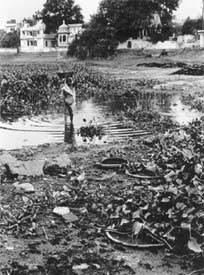
For the jss , which has been working towards cleaning up these lakes since 1992, the judgement has come as a shot in the arm. Udaipur lakes, to which the city owes its identity, are in a pitiable condition. The beautiful lakes are now turning into cesspools, largely due to the dumping of heaps of waste and garbage, uncontrolled growth of water hyacinth and heavy siltation. As a result, groundwater levels have also fallen. "The situation is alarming. If we don't capture the rains, there could be drought in Udaipur,' fears Tej Razdan, secretary of jss .
A sustained campaign Since 1969, a large number of Udaipur residents have been actively participating in programmes to clean up the lakes. But ever since the jss was formed in 1992, their protests have found a formal platform. Initially, the jss tried to involve ‘the 11 masters of the lakes' — the 11 government departments which are responsible for the upkeep of the lake system. However, they found that there was no coordination between the various departments and every department was passing the buck to one another. In spite of their best efforts, no long-term solution appeared in sight. Though several petitions have been doing the rounds in the courts for several years (see box: Courting action ), the courts had been hoodwinked by the government into believing that remedial action had been taken. It took a fresh petition in 1997, filed by jss , that finally informed the courts that the situation had only deteriorated. Seeing that there was no change in the situation, a fresh petition was filed by jss member Rajendra Razdan in 1999.

The case is now being heard by Justice N N Mathur and Justice D N Joshi who have taken a special interest in the case: they hear the case on a fortnightly, even weekly basis. On May 8, the court passed an interim order directing the Jheel Vikas Society, formed by the government, to prepare a time-bound action plan to overcome the problems related to the lakes of Udaipur and submit a report by May 24. The court directed that for expediting the execution of the action plan, task forces must be constituted for dealing with various issues associated with the lakes like desilting, sewage diversion, treatment and disposal, safety of Pichola and Fateh Sagar lakes and preventing of construction in the ‘no construction zone' as well as developing the catchments of these lakes. The court also directed that each task force must include city residents and ngo s.

Significantly, the court directed that the excavation of the lakes be undertaken on a war footing, instructing the use of extra machines and the resources of Hindustan Zinc Limited and other public sector organisations. The court was explicit in its directions, leaving nothing to chance. The municipal council of Udaipur was directed to consider the feasibility of putting big wagon-type containers at waste collection points. The state pollution control board was directed to provide a list of cases pending in the courts for violation of pollution laws, where notices had been served and action had been taken. The collector of Udaipur was directed to remove all illegal encroachments within eight weeks. However, the authorities did precious little.

Frustrated at the lacklustre attitude of the implementing agencies, Razdan petitioned the courts. On May 24, the court expressed its unhappiness at the way its interim order was being implemented. The government was pulled up for not proceeding beyond paper work and simply constituting a task force. Even the report that was submitted before the court was criticised. The court found vital issues not addressed and a singular lack of determination on the part of the administration to tackle the problem. The court was particularly critical of the divisional commissioner and the chairperson of the Jheel Vikas Society, who failed to coordinate the action needed from various departments. The court gave the chairperson and other officials a last chance to comply with the directions that the court gave on May 8.

On June 1, Rajendra Razdan of the jss told the court that desilting of four lakes — Fateh sagar, Swaroop sagar, Rang Sagar and Kumhariya talab — was not being done properly. He said that the public health and engineering department had not stopped pumping the highly polluted Swaroop sagar lake water into Fateh sagar.

In compliance with the previous court orders, the divisional commissioner and chairperson of the society appeared before the court and submitted a time-bound action plan. Taking note that the lakes of Udaipur had been identified for conservation under the National Lake Conservation Plan of the government of India, the court directed that the secretary, Union ministry of environment and forests be impleaded as respondent. The next meeting of the court has been fixed for July 10.

Lake legacy
Situated in the saucer-shaped valley, Udaipur has four main lakes: Pichhola, Rang sagar, Swaroop sagar and Fateh sagar. All the lakes are ingeniously engineered and interconnected — overflow from one goes to another. The lakes are part of the Udaipur lake system and is linked to the Udai sagar lake, towards the east of the city.

Used for sources of drinking water, these lakes have been subjected to rampant pollution over the past few years. So bad is the pollution that in the case of water from the Swaroop sagar, the filtration plant just cannot deal with the load because the filters get clogged. To deal with this, the public health and engineering department is pumping the water from this lake into the comparatively cleaner Fateh sagar and then passing this mix through the filtration plant. The result: pollution of the Fateh Sagar.

According to Razdan, not only has the groundwater table declined but whatever water is pumped out is not fit for drinking. These lakes, therefore, have become the only the source of water for the city residents. But as these lakes are polluted due to the lack of adequate water treatment plants, the water unfit for consumption. Almost 80 per cent of Udaipur's residents suffer from water-borne diseases, says Razdan.

The city, with a burgeoning population, now nearing 500,000, and a large influx of tourists, has an inadequate sewage system. An estimated 53 hotels and 10,000 houses, accommodating 80,000 people, are located around the lakes.

The lakes also receive sewage and wastewater from 45 drains; have 73 ghats (used for washing and bathing purposes) and have 42 garbage dumps. Over the years, a large number of hotels have also sprung up on the banks of the river which has increased the pollution load. Not surprisingly, with all this polluting load water hyacinth, an aquatic weed, has covered most of the small lakes. It has also partly covered Pichola and Fateh sagar. Boating has also spread a layer of oil (the boats run on diesel) in Pichola and Fateh Sagar. Moreover, rampant destruction of forests in the catchment areas in the Aravalli hills has resulted in heavy siltation. This has reduced the depth of the lakes.

But now, thanks to the court intervention, all stakeholders in Udaipur — the government, citizens and industry — are chipping in to ensure that the rains are captured this monsoon. Desilting is now being done properly. "Unless the silt accumulated at the lake bottom is completely scraped out, the desilting operation will not be of much help in restoring groundwater recharge rate to its original value,' says R N Ahtavale, eminent hydrogeologist at the National Geophysical Research Institute, Hyderabad. It is now up to the rain gods to shower their blessings.

Jun 2000
Indira Khurana
Down to Earth 9 20000630

Footer Separator Box